What ChessPillar does
Five workspaces, each answering one question. What each does today, and what is still arriving.
Today: what should I do now?
Open the app and one step is waiting, with the reason it was chosen. The plan takes the deciding off you, so a short session goes on the chess.
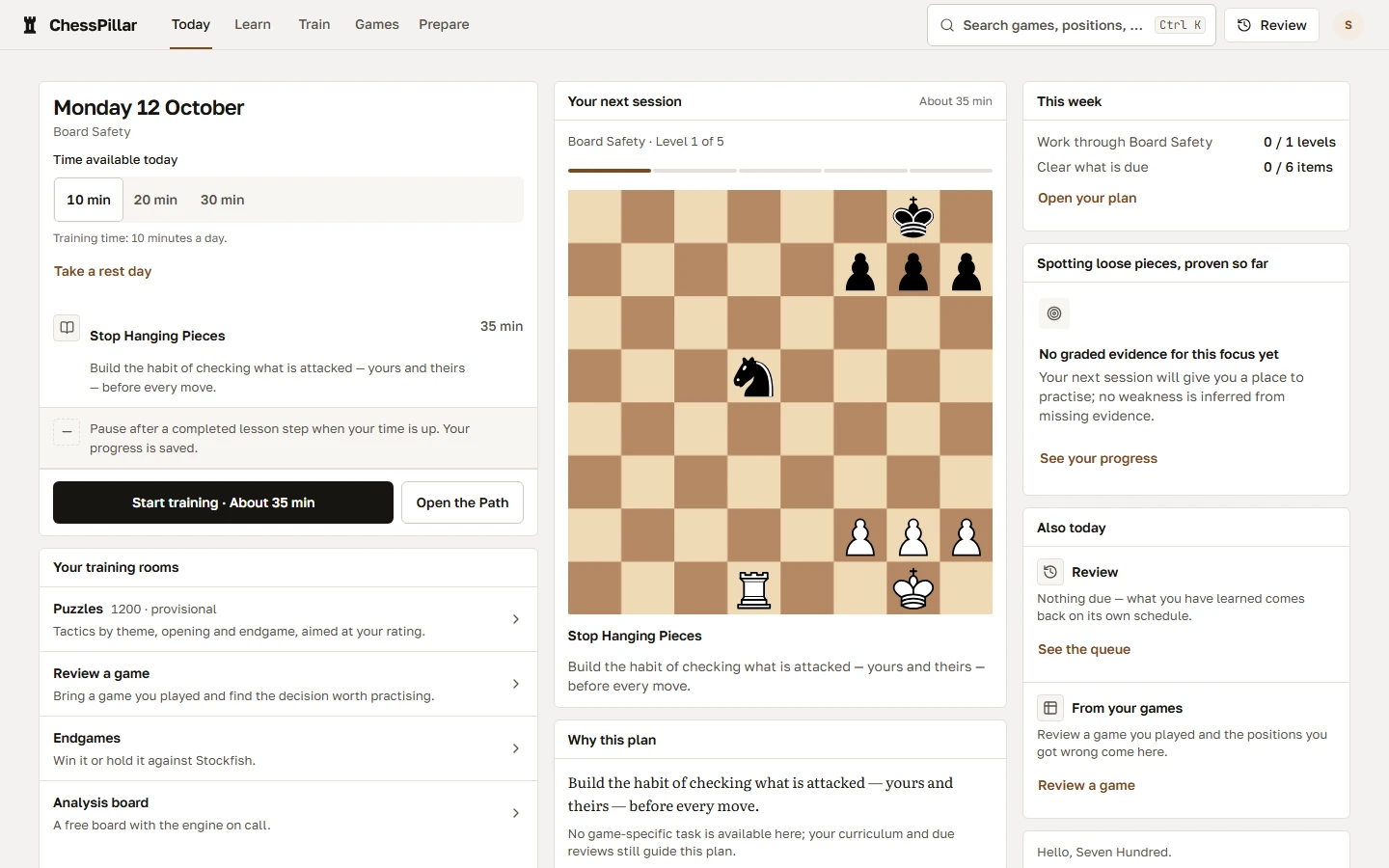
Product capture. Sample data.
- One step at a time
- The planner prescribes a single Mission: the next Level, a review that is due, a Fight you have earned, or a game worth a second look.
- A reason you can read
- Every Mission says why it was chosen, in plain words: a review is overdue, a gate is not met yet, a Boss is ready, the same mistake came up in your games.
- Fixed rules decide
- A fixed order of priorities decides. The same record always gives the same prescription, and no language model chooses what you do next.
- Nothing to keep up
- Due reviews are worked out when you open the app. Miss a week and nothing resets; the work simply waits for you.
- Start where you are
- Give your rating, or sit a short placement of up to 16 positions with no hints and no theme labels, and the curriculum opens at your level. A rating you report places you a little below it.
- Your week, set to your time
- At setup you say how much time you have each week, and the weekly plan is shaped to fit it.
Learn: what should I understand?
Reading an idea is different from owning it. Each Level teaches one idea, then makes you find it, calculate it and use it on boards you have not seen, with less help each time.
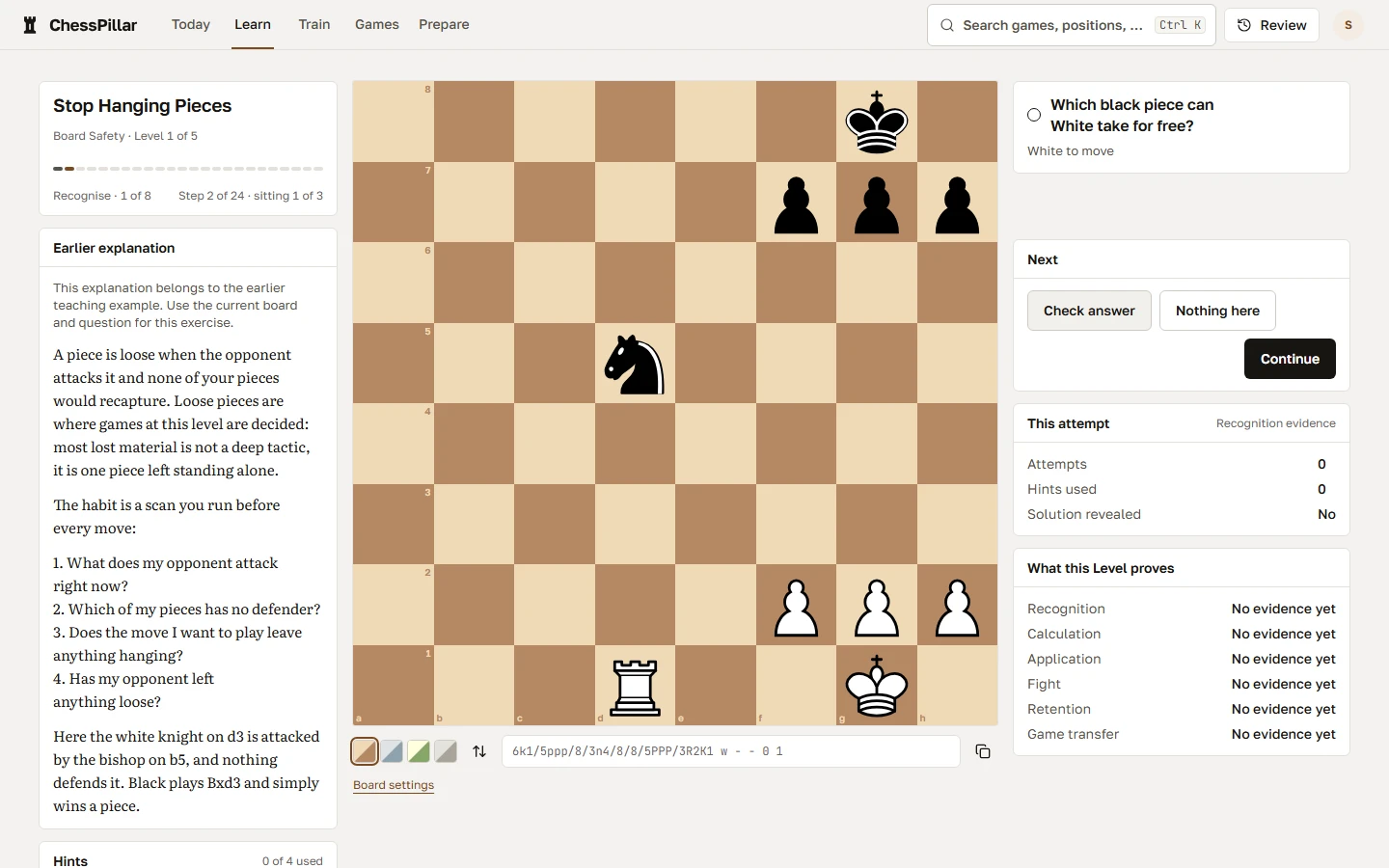
Product capture. Sample data.
- 116 Levels, all live
- Across 12 rating bands, from a first game to 2400, in one order. See the whole curriculum
- A four-rung hint ladder
- Hints open one at a time, from a strategic nudge to a concrete one, so you get unstuck without being handed the move. A hint lowers the credit an answer earns; it never cancels it.
- Boards with nothing to find
- 505 positions in the course have no tactic at all, and saying so is the right answer. A game never announces that something is there.
- A gate you pass with evidence
- The next Level opens when this one’s evidence is in: accuracy on each kind of exercise, and a Fight where the Level asks for one. Once met, a gate stays met.
- The Boss
- At the end of a world, what it taught comes back at once: mixed, unlabelled, with no hints. Passing takes the overall score and a floor on each skill the Boss tests.
- Theory
- The released theory library, Atlas, is open to every learner.
Train: what should I practise?
Practice that holds up under pressure and still holds weeks later.
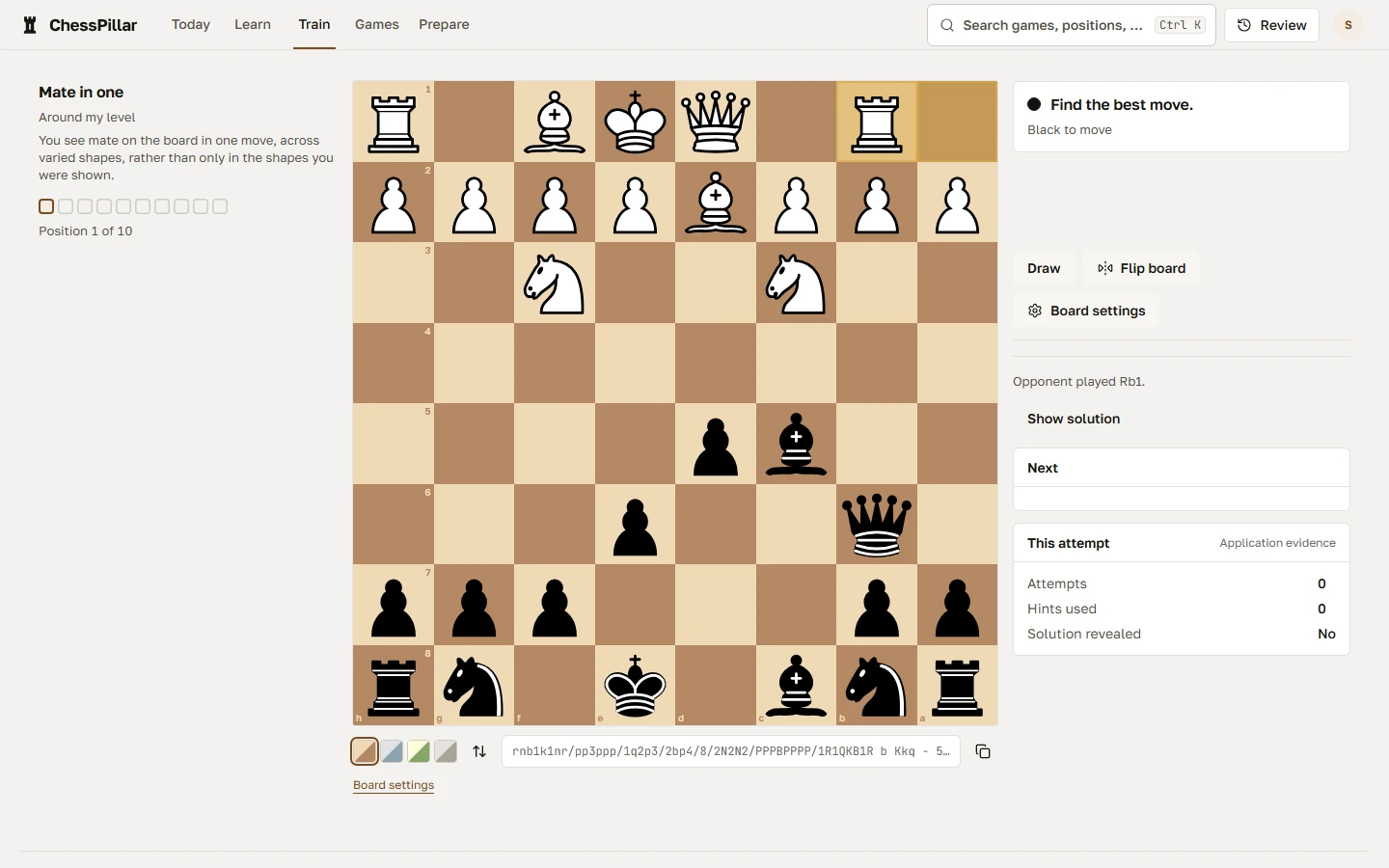
Product capture. Sample data.
- Fight the position
- Play a real position out against Stockfish toward a stated goal: convert it, hold it or survive it. 38 Fights are live, each tied to one Level. Nothing evaluates you while you play, and you find out when it ends.
- The memory ladder
- A proved skill comes back after 1, 3, 7, 16, 35 and 70 days, on positions drawn from every Level that teaches it. A miss steps back one rung, and the skill climbs again from there.
- Puzzles
- 0 positions in 27 modes, from mixed and unlabelled to mate in three, defence, quiet moves and positions from your own games. Rated as you go, with unrated and untimed modes when you want them.
- Calculation trainer
- Sessions of eight positions, including a mode where you write the whole line down before anything is checked. Mistakes are named: a missed candidate, a missed reply, a line stopped too early.
- Visualization trainer
- Sessions of eight: hold the board in your head, write a line out in notation, and board-vision drills from coordinates to knight routes. The ladder takes the pieces away step by step, down to notation alone.
- Endgames
- 56 theoretical positions in five families, each with a stored tablebase verdict. Your moves are checked against the tablebase as you play.
- Your mistakes as drills
- Positions you got wrong become your own puzzles. One retires after three correct in a row and returns if the mistake does.
Games: where is my chess work?
Your games hold the evidence of what costs you points. This workspace keeps them, reviews them and turns them into practice.
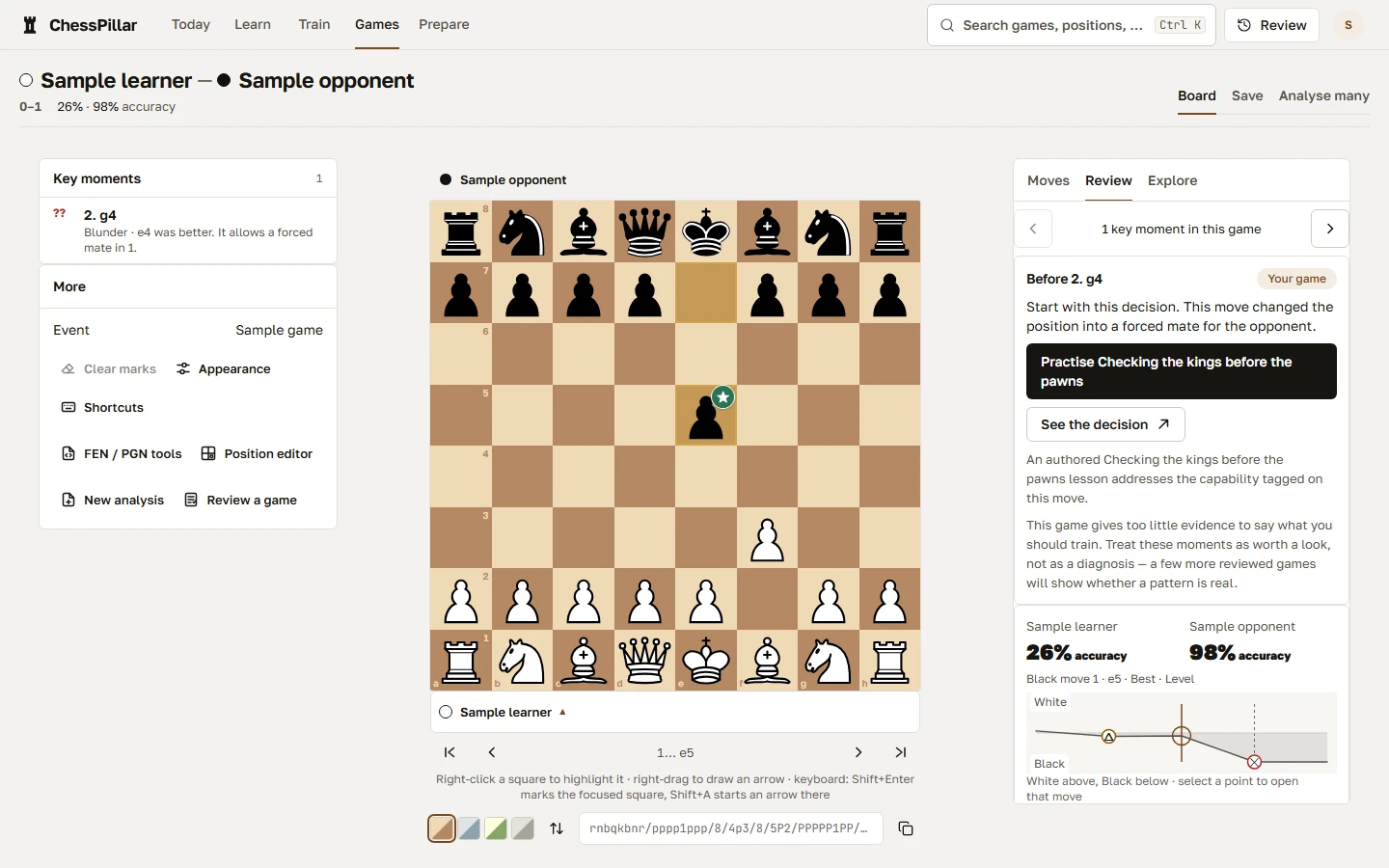
Product capture. Sample data.
- Bring games in
- From Lichess by username, or paste or upload a PGN. Your games stay private unless you choose to share. Stockfish reviews the game in your browser.
- Review in your browser
- Stockfish 18 runs on your own device, in a background worker. The review works out where the game turned, then marks every move from blunder to brilliant.
- Straight to your first error
- A game opens on the first move that cost you, with accuracy, error counts, the evaluation across the game and the best line. Every move is marked, from blunder to brilliant.
- Repeated mistakes get a name
- A mistake that recurs across games becomes a named leak, with a fix attached: a Level, a drill or a repertoire repair. When it keeps coming back, Today schedules the fix.
- Studies
- Annotated chapters with folders, comments and PGN export. Train a chapter on a spaced schedule or play it from memory, and share it privately, by link or in public.
- Game database
- Search your game collections by player, result, time control, pawn structure, tactical motif, or an exact or similar position. Opening, novelty, tournament and tactical reports.
- Analysis board
- Stockfish 18 in your browser with up to five engine lines, nested variations, a board editor, keyboard navigation and read-only share links.
- Yours to take
- Export everything from Settings, as PGN and JSON, at any time.
Prepare: how should I approach my next game?
Repertoires, reference games and tournament work in one place, so preparation connects to what you train.
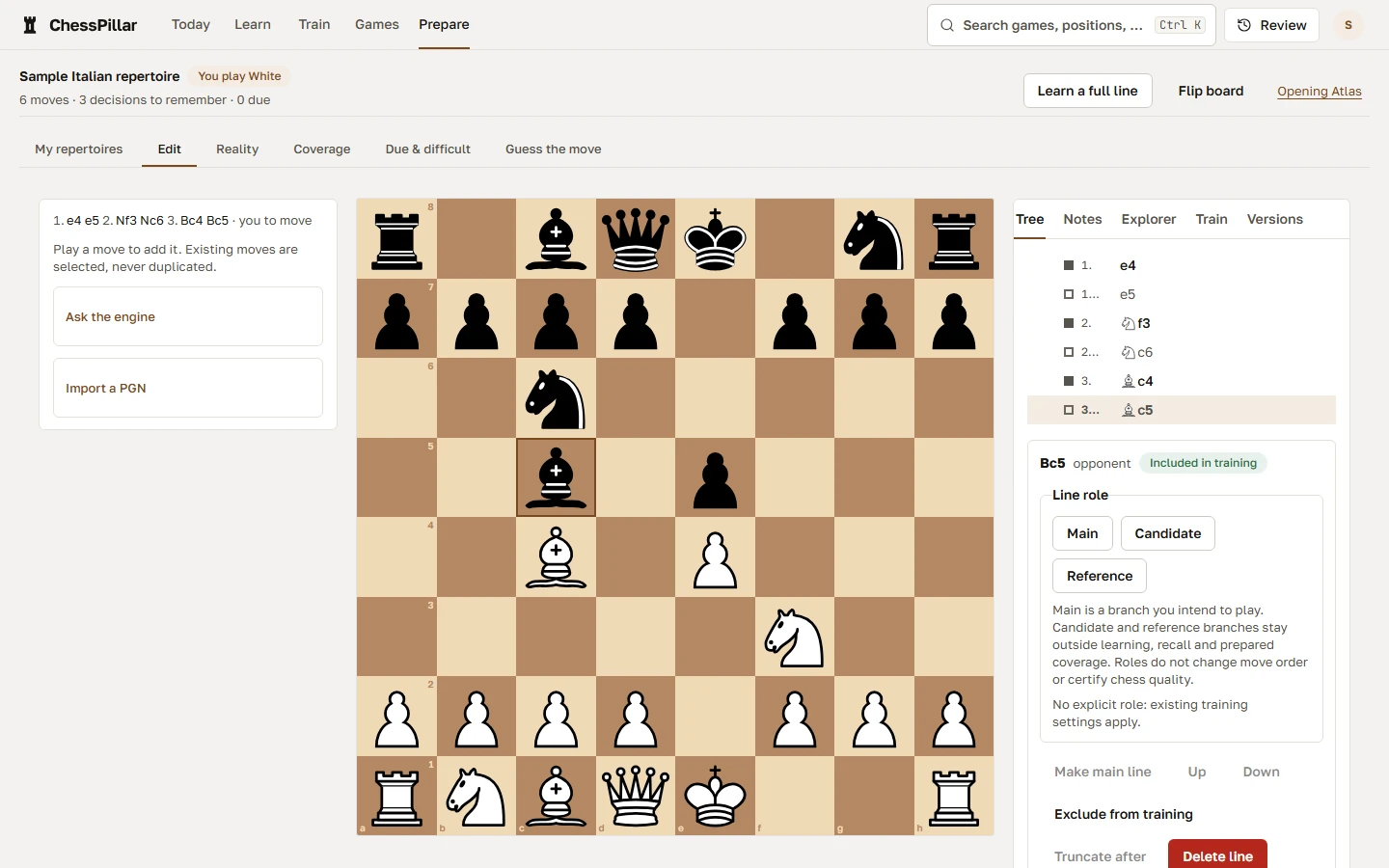
Product capture. Sample data.
- Opening repertoire trainer
- Build your lines, then drill them on a spaced schedule. Coverage shows the replies you have no answer for, and your imported games show where you left your preparation.
- Game database
- Search your game collections by player, result, time control, pawn structure, tactical motif, or an exact or similar position. Opening, novelty, tournament and tactical reports.
- Broadcasts
- Follow live tournaments round by round, with boards that update as moves arrive. No account needed to watch.
- Opponent dossiers
- Choose a verified opponent, a date range and game types. See their repertoire by colour, recent tendencies and representative games, and how it overlaps with yours. Every tendency links to the games behind it, and a thin sample is reported as thin.
- Preparation packs
- Expected branches, your chosen response, a model position and a rehearsal you can run on your phone. Editable, with a printable summary.
- Event workspaces
- Several opponents in one tournament, with preparation deadlines and repertoire freshness and gap reports.
- Rules codeEvery position and move is legal.
- Stockfish2,118 positions carry its stamp.
- TablebasesSmall endgames, answered exactly.
Chess answers come from rules, engines and tablebases.
Rules code and Stockfish decide what is right, and tablebases settle small endgames. All 2,118 positions in the course carry a Stockfish verification stamp. No language model grades an answer.
Free during the closed beta No card required